.png?width=300&height=95&name=Peak_Energy_WHITE_in_line_logo-removebg-preview%20(1).png)
For more than ten years, the rule for counting clean electricity has been fairly simple. A company could buy enough renewable energy certificates to cover its yearly consumption and then report that its electricity was renewable.
That rule is now being rewritten.
The Greenhouse Gas Protocol (GHG Protocol) is the global standard most companies use to measure their emissions. It is reviewing how companies should count the electricity they buy, known as Scope 2. The final rules are not expected before late 2028. But the direction is already clear, and it matters for any company buying clean power today.
The contracts you sign now will be judged by tomorrow's rules.
What is changing: three simple ideas
The proposed revision rests on three ideas.
1. Time. Clean electricity would need to match the hour when it is used, not just the total over a year. Solar power produced at noon would no longer cover electricity used at midnight.
2. Place. Clean electricity would need to come from the same connected grid area where it is consumed. A certificate from a distant market might no longer count.
3. Real impact. The standard setter is also exploring a separate way to show how much a purchase actually reduces emissions on the grid. This figure would be reported alongside the main emissions results rather than mixed into them.
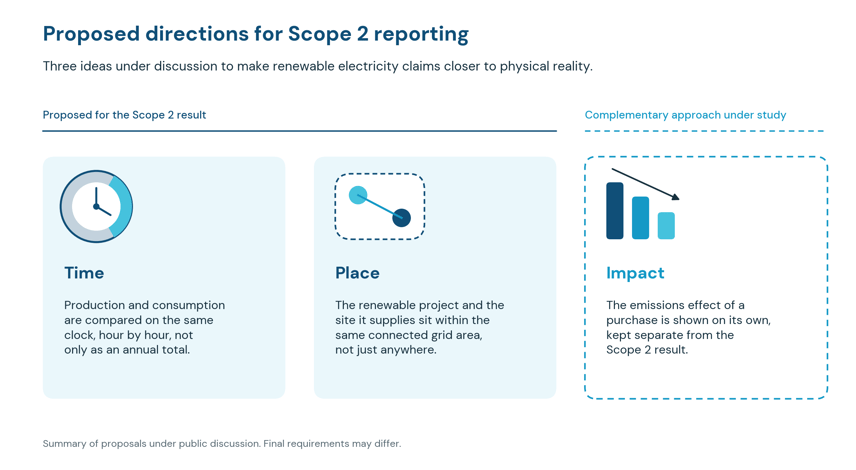
Together, these proposals could tighten certificate eligibility.
When will this happen?
The debate is still open.
A public consultation ran from October 2025 to January 2026. The feedback was mixed, and many respondents raised concerns about cost and feasibility, particularly on the time and place requirements.
How existing contracts will be treated is also undecided. One option would protect them for a limited period. Another would set a single start date for everyone, with time to prepare.
So nothing changes in your reporting tomorrow. But that does not mean nothing needs to change in your planning.
Why waiting is still a risk
Your contracts will outlive the debate.
A power purchase agreement (PPA), a long-term contract to buy electricity from a specific project, often runs 10 to 20 years.
A contract signed in 2026 will still be running long after the new standard takes effect. Whether older contracts will be protected remains an open question.
Target-setters are already moving.
Following the June 2026 release of its new Net-Zero Standard V2.0, The Science Based Targets initiative (SBTi) is enforcing strict Scope 2 rules well ahead of the GHG Protocol.
Taking effect on February 1, 2027, and becoming fully mandatory on February 1, 2028, the standard requires clean electricity to be local and sourced from power plants under 15 years old. Additionally, large consumers must track their green energy hour by hour by 2030. For thousands of companies, the era of easy, unbundled certificates is already over.
Certificates may become more expensive.
When the rules narrow which certificates count, prices tend to rise. The same analysis found that in one market where certificates had to come from within the region, prices rose three to seven times.
Good projects take time to secure.
Grid connections, land, permits and financing do not appear overnight. Buyers who define their needs early have more choice. Buyers who wait for the final rules may be left competing for what remains.
Your numbers face more scrutiny.
Climate reporting is becoming mandatory and audited in more markets. A Scope 2 figure has to stand up to questions from auditors, investors and customers.
What well-prepared buyers are doing now
Companies that handle this well are not rushing into commitments. They are asking better questions, and there are four practical steps.
- Know where your clean electricity comes from. Review the share of your current Scope 2 result that depends on certificates bought far from your sites.
- Understand when you use power. Hourly or even monthly consumption data shows how well your clean supply matches your actual demand.
- Favour real, local capacity. Contracts linked to new projects, connected to the same grid as your operations, are more likely to hold their value as the rules tighten.
- Build in flexibility. Battery storage and combined solar-plus-storage solutions can help cover more hours of the day. Contract terms can also anticipate changes in accounting rules.
From accounting question to infrastructure decision
This is where Scope 2 stops being only a reporting exercise.
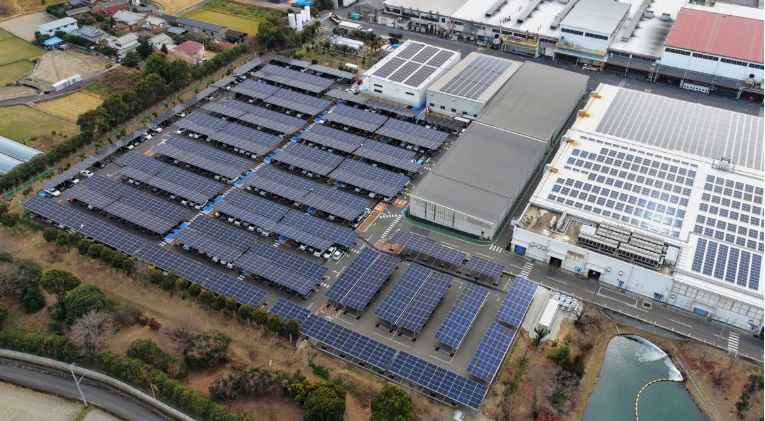
Under the direction these rules are taking, the most robust way to back a clean electricity claim is real infrastructure: projects close to where the power is used, supplying electricity when the business needs it.
That is the work Peak Energy does.
We develop, finance, build, own and operate renewable energy and battery storage assets across Asia Pacific. All while supplying businesses through onsite projects at their facilities and offsite projects connected to their grid. We also offers storage and hybrid solutions that help match clean supply to demand across more hours of the day. Under suitable PPA structures, customers can access this without upfront investment. As the long-term owner and operator of these assets, Peak Energy remains accountable for their performance throughout the contract. With Stonepeak's backing, we can confidently engage in long-duration projects.
No one can say exactly how the final standard will read. What companies can control is whether their next clean energy decision is built on assets that will still count as the rules tighten.
Sources :
GHG Protocol, "Key Standard Development Updates: FAQ Resource" (29 July 2026)
GHG Protocol, Scope 2 public consultation release (20 October 2025)
SBTi, "Introducing the Corporate Net-Zero Standard Version 2.0" (June 2026)
Watershed, "Analyzing the GHG Protocol's proposed scope 2 changes" (January 2026)