
Japan imports more than 85% of its primary energy, according to IEA country data, a structural vulnerability that translates directly into electricity costs for manufacturers. When LNG spot prices spiked across Asia in recent years, factories operating on grid power absorbed the full impact. For multinational manufacturers running production lines in Kagawa, Aichi, or Chiba, this exposure is not theoretical. It is a line item that compounds every quarter.
Jump to FAQs ↓Discuss your solar project
Industrial rooftop solar systems offer a practical counter to that exposure: on-site generation that converts unused roof and parking surfaces into fixed-cost power sources. For factories in Japan, where land is scarce and grid tariffs remain among the highest in Asia, rooftop solar is no longer a discretionary investment. It is an operational hedge.
This article explains how industrial rooftop solar works within Japan's regulatory, structural, and commercial context.
Key Takeaways: Industrial Rooftop Solar for Factories in Japan
- Japan's high grid tariffs and fossil fuel import dependency make on-site solar generation a direct cost-reduction lever for factories.
- Rooftop solar and solar carport systems require no additional land, a decisive advantage for space-constrained Japanese industrial sites.
- Long-term on-site PPAs eliminate upfront capital expenditure while locking in electricity rates below grid tariff for 15 to 20 years.
- Peak Energy designed, financed, and installed a 2 MWp solar carport for Toyota Group supplier JTEKT, delivering nearly 40% electricity cost savings.
- Combining on-site solar with offsite PPA structures allows manufacturers to cover a larger share of total consumption without additional roof area.
Why Japan's Energy Market Pressures Factories Toward On-Site Solar
Japan's electricity market is structurally expensive. Commercial and industrial tariffs reflect a generation mix that still relies heavily on imported LNG, coal, and oil. The renewable energy surcharge adds further cost pressure, and recent yen depreciation has amplified the impact of dollar-denominated fuel imports on domestic electricity prices.
For manufacturers, this translates into unpredictable operating costs. A factory consuming 5,000 MWh per year faces annual grid expenditure that can swing by tens of millions of yen depending on commodity cycles and regulatory adjustments.
On-site solar generation addresses this problem at its root. By producing electricity on factory rooftops or parking structures, manufacturers replace a variable cost with a fixed one. The financial logic is straightforward: every kilowatt-hour generated on-site is a kilowatt-hour not purchased from the grid at volatile rates.
How Industrial Rooftop Solar Systems Work on Factory Sites
Industrial rooftop solar in Japan typically involves photovoltaic modules mounted on factory or warehouse roofs using non-penetrating clamp systems compatible with standing-seam metal roofing. This approach preserves roof integrity and avoids warranty complications. Installations range from several hundred kilowatts on a single building to multi-megawatt systems spanning entire manufacturing campuses.
Self-consumption is the primary operating model. Factories with high daytime electricity demand, such as automotive parts plants, food processing facilities, and cold storage operations, consume nearly all solar-generated power on-site. Self-consumption rates above 85% are common in energy-intensive manufacturing environments, meaning minimal energy is exported to the grid.
Where rooftop area is limited, solar carport structures over employee or logistics parking provide additional generation capacity. These installations require more complex structural engineering and safety coordination, particularly on active industrial sites where construction must proceed without disrupting production.
What Makes Japan's Factory Environment Distinct for Solar Deployment
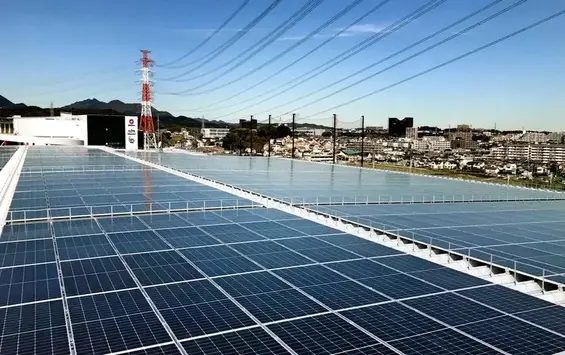
Japan's industrial solar landscape differs from other APAC markets. Available land is constrained: Japanese factories typically operate on compact sites with limited surrounding acreage. Rooftops and parking areas often represent the only viable surfaces for on-site generation.
Second, structural standards are rigorous. Japan's seismic codes and wind load requirements demand engineering precision that exceeds standard commercial solar specifications in most other markets. Every mounting system must account for earthquake loads, typhoon-class wind speeds, and in northern regions, heavy snow accumulation.
Third, regulatory momentum is accelerating. From 2026, Japan's revised Energy Conservation Act requires designated energy-intensive businesses to report rooftop solar installation targets and roof suitability data. The parallel launch of the GX Emissions Trading Scheme introduces carbon pricing for major emitters. Together, these regulations shift rooftop solar from optional to operationally essential for many manufacturers.
How On-Site PPAs Eliminate Upfront Capital for Manufacturers
Most multinational manufacturers in Japan prefer to avoid deploying capital expenditure on non-core assets. On-site power purchase agreements solve this: a specialist developer designs, finances, builds, owns, and operates the solar system on the factory's premises. The manufacturer pays only for the electricity generated, at a rate fixed below grid tariff for the contract duration, typically 15 to 20 years.
Under this model, the developer assumes all technology risk, performance risk, and maintenance responsibility. The manufacturer gains immediate cost savings and a predictable electricity price with zero upfront investment. At contract end, ownership of the system transfers to the manufacturer or the developer removes it.
Peak Energy operates precisely this model across Asia Pacific. We develop, finance, install, and provide full operations and maintenance (O&M) over the contract term, enabling factory operators to focus on production rather than power infrastructure.
Real-World Results: The JTEKT Solar Carport in Kagawa
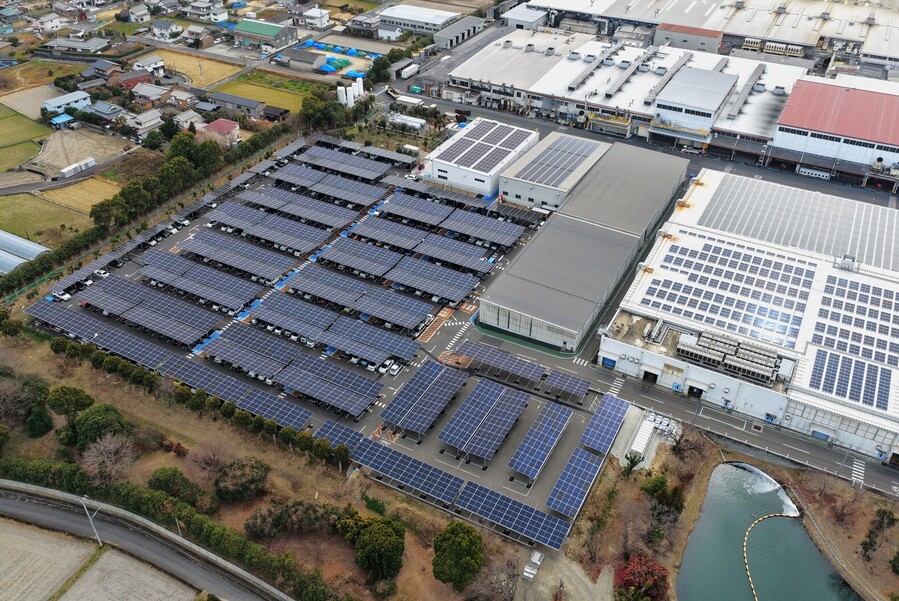
The 2 MWp solar carport at JTEKT’s Kagawa facility, Japan.
Toyota Group supplier JTEKT Corporation commissioned a 2 megawatt-peak (MWp) solar carport at its Kagawa facility under a 20-year PPA with Peak Energy. The system covers 640 parking spaces and was completed in five months. Annual generation is approximately 2,500 MWh, avoiding around 1,090 tonnes of CO₂ emissions per year.
JTEKT expects to save nearly 40% on electricity costs through solar-generated power compared with grid purchases. Under the long-term PPA, Peak Energy designed, financed and installed the system and will provide full O&M over the contract term.
This project demonstrates that industrial-scale solar can be deployed on active manufacturing sites without disrupting operations. Carport structures built over existing parking require meticulous structural engineering, safety management, and tightly managed installation sequencing around an active facility. The JTEKT project reflects that level of delivery discipline.
Complementing On-Site Solar with Offsite PPA Structures
For factories where rooftop and carport capacity covers only a portion of total electricity demand, offsite PPAs provide a path to higher renewable energy coverage. Under a physical offsite PPA, a developer builds a solar plant in the same grid region and wheels the electricity to the factory. The factory receives both the power and its environmental attributes.
Virtual PPAs offer an alternative: the factory continues purchasing grid electricity from its retailer while receiving renewable energy certificates (RECs) from a remote solar plant, reducing Scope 2 emissions on a market-based accounting basis.
Peak Energy is the partner of choice for JERA Cross and TEPCO to deliver offsite solar solutions that complement on-site installations. This combination of on-site generation with offsite procurement enables manufacturers to address a larger share of their energy consumption through renewables, even when physical roof or parking space is exhausted.

Site Assessment: What Procurement Leaders Should Evaluate
Before committing to an industrial rooftop solar project in Japan, energy procurement leaders should assess several critical factors. Roof structural capacity is the starting point: legacy factory buildings must be evaluated for additional dead load capacity, accounting for Japan's seismic and wind load standards.
Available roof area determines system size. A factory rooftop of 10,000 square metres can typically support 700 to 900 kWp of solar capacity after accounting for setbacks, equipment clearances, and fire access pathways. Carport additions can increase capacity by 20 to 40%, depending on parking lot dimensions.
Energy consumption profile matters. Factories with high daytime demand and consistent shift patterns achieve the strongest financial returns. Grid tariff structure, including demand charges, determines the value of each kilowatt-hour displaced.
The developer's track record on complex industrial installations is a procurement consideration that directly affects execution quality and long-term asset performance.
How Industrial Rooftop Solar Supports Scope 2 Reduction Targets
Multinational manufacturers operating in Japan face growing pressure from parent companies, OEM customers, and supply chain sustainability frameworks to reduce Scope 2 greenhouse gas emissions. On-site solar generation with retired renewable energy certificates (RECs) provides one of the highest-credibility instruments for Scope 2 market-based reductions.
For automotive suppliers under Toyota Group, Hyundai, or Honda decarbonisation mandates, demonstrable on-site renewable generation carries more weight than certificate-only procurement. It signals operational commitment and provides a transparent, auditable record of energy origin that satisfies GHG Protocol Scope 2 Guidance.
Japan's GX Emissions Trading Scheme introduces a further incentive: manufacturers covered by the scheme can use on-site solar output to reduce their carbon cost exposure directly. As carbon pricing tightens, the economic case for on-site generation strengthens in parallel.
In Conclusion: Industrial Rooftop Solar
as a Competitive Position in Japan
For multinational manufacturers in Japan, industrial rooftop solar is not a facilities project. It is a strategic procurement decision that affects energy cost structure, carbon compliance, and supply chain competitiveness for the next two decades. The manufacturers that secure capacity now will operate from a position of cost predictability. Those that wait will enter a tighter market.
Peak Energy develops, owns, and operates renewable assets across Asia Pacific, with 300 MW of operating capacity and 2 GW in development. In Japan, we deliver on-site solar and offsite PPA solutions engineered for the specific constraints and regulatory requirements of industrial operations.
FAQs About Industrial Rooftop Solar for Factories in Japan
What is industrial rooftop solar and how does it work for factories?
Industrial rooftop solar uses photovoltaic modules installed on factory roofs to generate electricity consumed on-site. Factories with high daytime power demand achieve self-consumption rates above 85%, directly reducing grid electricity purchases and stabilising energy costs over the system's operating life.
How much can a factory save with rooftop solar in Japan?
Savings depend on system size, grid tariff, and consumption pattern. Peak Energy's project with Toyota Group supplier JTEKT in Kagawa delivered nearly 40% electricity cost savings under a 20-year on-site PPA, demonstrating the scale of reduction achievable on energy-intensive manufacturing sites in Japan.
Does installing rooftop solar require capital expenditure from the factory?
Under an on-site PPA model, no. Peak Energy invests 100% of the capital required to design, finance, install, and maintain the system. The factory pays only for the electricity generated at a fixed rate below grid tariff, with zero upfront cost.
Can factories combine on-site solar with offsite renewable procurement?
Factories can pair rooftop solar with offsite PPA structures to increase renewable energy coverage beyond what roof area alone supports. Peak Energy partners with JERA Cross and TEPCO to deliver offsite solar solutions that complement on-site systems, covering a larger share of total electricity demand.
How does rooftop solar help factories meet Scope 2 emission targets?
On-site solar generation with retired RECs reduces a factory's Scope 2 market-based emissions under GHG Protocol guidance. For multinational manufacturers facing OEM decarbonisation mandates and Japan's GX Emissions Trading Scheme, on-site solar is among the highest-credibility reduction instruments available.
Discuss solar options for your factory
Contact Peak Energy to discuss your site, electricity requirements, and on-site or offsite solar options.
Discuss your solar project